
There is some evidence that high dose vitamin C effectively weakens or outright destroys cancer. However, the evidence is mixed. Years ago the Mayo clinic conducted a well controlled study and concluded that vitamin C is worthless in the fight against cancer. However, they primarily used oral forms, and recently wrote: “vitamin C given through a vein (intravenously) has been found to have different effects than vitamin C taken in pill form. This has prompted renewed interest in the use of vitamin C as a cancer treatment. There’s still no evidence that vitamin C alone can cure cancer, but researchers are studying whether it might boost the effectiveness of other cancer treatments, such as chemotherapy and radiation therapy.”
I started Intravenous vitamin C (IV-C) treatments shortly after my diagnosis. At lower serum levels vitamin C acts as an antioxidant and this does not kill cancer cells. However, one way to kill cancer cells is to expose them to pro-oxidants. In high serum levels vitamin C becomes a pro-oxidant. Many chemotherapy drugs act on the same principle. The majority of the IV-C cancer fighting action is due to the pro-oxidant effects (via reactive oxygen species or ROS). Although I think that IV-C treatments are effective they are expensive and inconvenient so I tried to find an alternative that would increase the serum levels of vitamin C up to the levels that I obtain with IV-C. I found some research that led me to entertain the possibility that a combination of oral and liposomal vitamin C can increase serum levels considerably (albeit not as high as IV-C) and has the advantage of remaining in the body for a substantial period of time, as well as being more convenient and less expensive.
However the National Institute of Health (NIH) states that IV-C can increase serum levels up to 14,000 uMol/l and oral can only get you to about 220 uMol/l.
Rather than jump to any conclusions I attempted to test serum C levels myself so that I could compare both methods. I came up with 4 methods: 1) urine test strips – I attempted to use those for blood serum measurements – they didn’t work properly. 2) Iodine/starch measurements – more accurate but I needed high quantities of blood. 3) Lab serum C analysis – accurate but very expensive to conduct my tests. It is also very difficult to coordinate 30 minute or 1 hour lab test intervals. 4) Diabetes glucometer. I spoke to Dr. James Spurgeon about this and he said that vitamin C mimics glucose, uses the same pathways, and raises the level of glucose (in this case serum C which is what we want) seen by the meter.
So I proceeded forth with the glucose measurements.
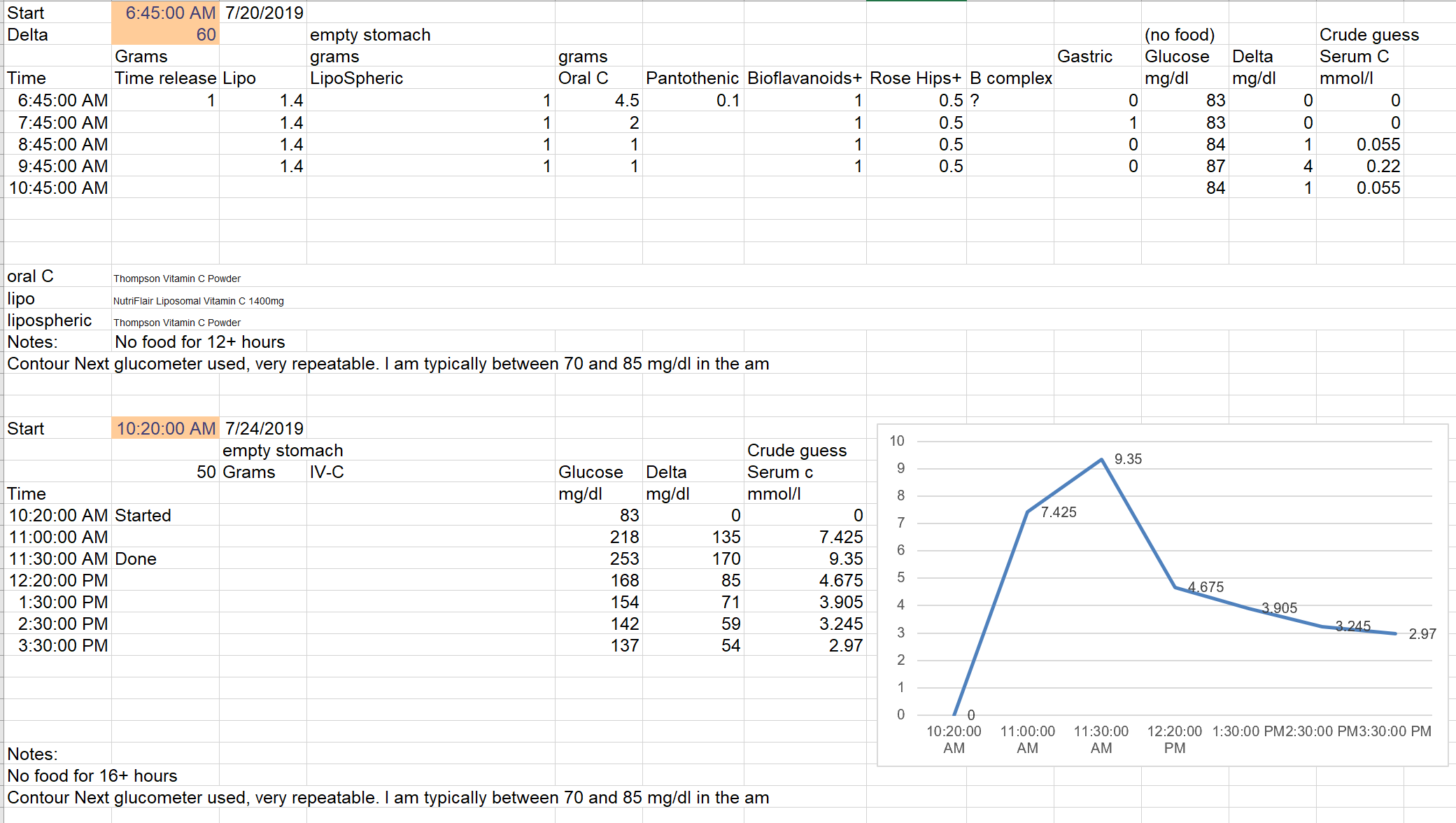
To summarize the results, the increase in serum C using oral and lipsomal vitamin C and some synergists is negligible. I measured up to about 220 uMol/l (.22 mMol/l) and this is what the NIH stated. Note that I’m not positive about the exact number since the resolution of the meter probably comes into play. Regardless, the serum C levels appear to be fairly low.
The increase from 50 grams of IV-C is considerable. I measured up to about 10,000 uMol/l (10 mMol/l) and the peak was quite likely more than that – agrees roughly with predictions from the NIH. The serum levels remained high for hours. Contrary to what some of the literature suggests. So I am continuing the IV-C once per week and discontinuing oral and liposomal vitamin C protocols. I do, however, get much more than the RDA for vitamin C from my diet; which includes a fair amount of fruit and vegetables.
To take advantage of the pro-oxidant affects of vitamin C it is important to note that research has shown that you can kill most cancer cells in the laboratory with values between 0.5 to 3mMol/L. Serum C levels probably need to be over 19.25 mMol/L (or 19250 uMol/L).
I encourage you to use a blood glucometer to do your own testing. They are inexpensive and simple to use. As of the time of this writing the Contour Next is one of the most accurate ones. If you’re like me you want to see things with your own eyes…
These are the results of my testing:
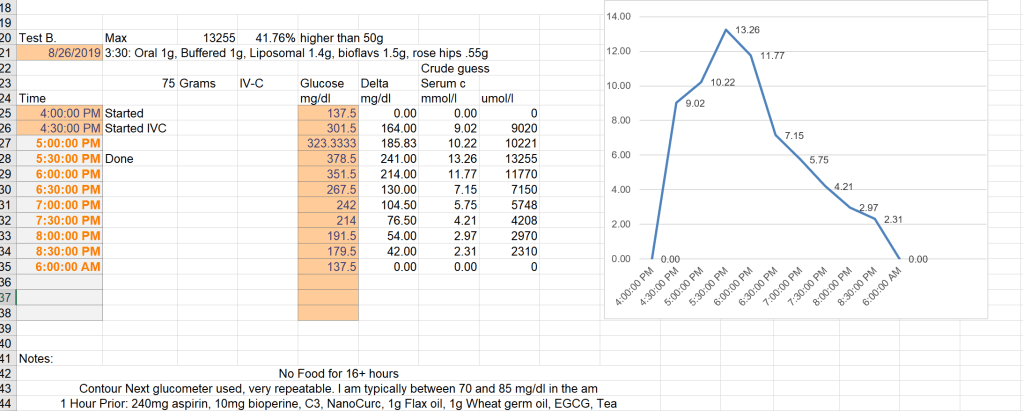
Here is another result. Some oral vitamin c, rose hips, bioflavanoids, 75G IV:
Selenium supposedly potentiates vitamin C. So I am going to add 40ug (note that the RDA is 55ug) into the IV and see if it makes a difference.
I’ve spoken with a couple of doctors about my measurement technique. Both doctors think that a glucometer test is more accurate than a lab test (C degrades in serum and the sample needs to be frozen – any delay after thawing or before it freezes affects the result).
Further testing leads me to believe that, for me, 100g of IVC is the minimum needed to enter a therapeutic zone. Peak serum values were measured after 3 sessions and were 18800, 19300, and 19800 umol/L (therapeutic zone is about 19250 umol/L). 40ug of Se was added to the IV for the final two tests and this appears to increase the serum C levels about 4%. This should be verified.
I am currently experimenting with a “burst” method of IV-C 3-5 consecutive days during one week each month.
I’m going to conduct some tests using the “burst” and see how multiple treatments affect the overall serum C level.
Summary:
- Oral and liposomal C result in negligible increases in serum C levels. 40ug Se in the vitamin C IV increases serum levels about 4%. 100g of IV-C gets me into the therapeutic zone.
- Supplements and drugs are recommended with IVC.
- These include:
- EGCG (500-1000mg)
- Curcumin (800-2400mg with 10-30mg piperine and 5g olive oil)
- A lipophilic statin. Atorvastatin is perhaps the best one to use. However, I use 20mg simvastatin because it has a short half life and I suffer insomnia as a side effect from longer half life statins.
- Metformin (500-1000mg)
- Melatonin (50-100mg)
- Vitamin D3 (50kIU)
- K2 MK-7 form (5mg)
- HCA (250mg)
https://lpi.oregonstate.edu/mic/vitamins/vitamin-C/supplemental-forms


 Prostate Cancer Adventures
Glad you have a way to share this info with others and also that the course of treatment appears to be well within the economic capacity for most. Keep up the healing and hoping that you get to say goodbye to cancer forever.
LikeLiked by 2 people
Thanks. I have a lot of info to share. I am going to try to write 3 posts a week.
LikeLike
Hi,
I (76 old) read and read .. everything so different to germany .. like BAT SPT Etc. I have PCa surgery .. radiotreatment now ADT with PSA 8 ng/ml and lot of orthomolecular stuff. How and with what you measure your blood glucose so exakt also vit c in serum (micromol etc thats really exact) ?
And can you give some links to studies pesae .. would be very nice
Arist
LikeLiked by 1 person
Hi Arist,
This is the blood glucose meter that I use: https://www.contournext.com/products/contour-next-one/
Resolution on the readout is 1 mg/dl but the accuracy is only +/-8.4%. I consulted with a doctor and found out that using a blood glucometer to measure serum vitamin C is more accurate than lab measurements. The reason is that the blood is tested right away vs. allowing vitamin C to degrade prior to the lab measurement. Lab measurements “could” be more accurate but I’d probably need to be at the lab and have the measurement done right after my blood was sampled.
What studies are you interested in? (using a glucometer to measure serum vitamin C?)
Russ
LikeLike