
Exercise has been shown to have a preventative effect against PCa. And studies indicate that it has an even more dramatic effect on PCa death.
From an NIH study of over 2,000 men: Men who exercised vigorously more than 3 hours per week of vigorous activity had a 61% lower risk of PCa death compared with men with less than 1 hour per week of vigorous activity. Men exercising vigorously before and after diagnosis had the lowest risk.
Vigorous exercise increases your heart rate enough to make you breath hard and sweat. The standard formula gives you a range of 110-125 beats per minute (BPM) but this is very dependent on the individual, how fit they are, what altitude they are at, etc. And of course check with your doctor first if you aren’t used to exercise. They might want you to ease into it or reduce your pace.
Moderate exercise is also good but perhaps not as beneficial as vigorous exercise (for the same number of hours, but this depends on many other factors). Moderate exercise is intense enough to make it hard to have a normal conversation. One of the benefits of moderate exercise is that it is much easier to do it for a longer time. I love just sitting on my upright exercycle, working on my computer or reading, and peddling away. Generally my heart rate is between 90 and 100. I can do this for hours but watch my time because too much might not be good.
The bike I use is the Exerpeutic ExerWorK 1000 Fully Adjustable Desk Folding Exercise Bike. (I’m not affiliated with the company in any way and have no incentive to advertise the product)
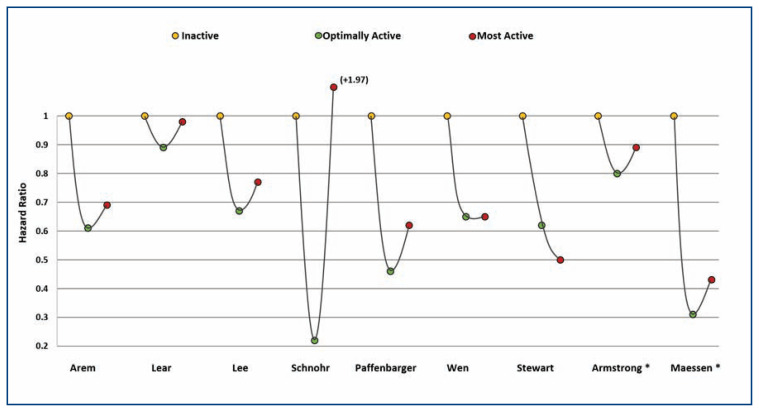
There seems to be even higher risk reduction if a man exercises more than 6 or 7 hours a week. Exercising more than maybe 10 or 15 hours a week is counterproductive. Mortality risk goes up.
I use a stationary bicycle, a treadmill, box, hike, bike, and use a jump-rope for 5 or 6 hours a week and lift weights 6 or so hours a week (I’m on the edge of overdoing this but I love it), and practice Yoga and Pilates maybe half an hour a week.
I’ve found that using an IR sauna for 20 minutes or so after a workout seems to help muscle growth. I wouldn’t put money on it though – just what I think I’ve noticed. I also wrap BFR bands (tight wraps to restrict, but not block, blood flow to arms and/or legs). Seems to maybe increase vascularity and maybe increases muscle due to metabolic stress. But, again, I’m not sure. Just what I “think” I’ve noticed.
There are many possible reasons for the beneficial effects of exercise:
- Results in blood vessel utilization to bring nutrients to the muscle cells. Cancer cells need to use blood vessels to feed themselves. The busier the blood vessels are then the less focused they can be on cancer growth.
- Helps get the circulatory system working.
- Causes various hormonal changes and the ones that I can think of appear to me to be positive for us and bad for PCa.
- Oxygenation increases.
- Boosts the immune system.
- Increases mitochondrial action. I’m not sure if this would be good or bad for cancer.
- Uses glucose and the more that is used, the less for cancer.
- When a muscle contracts (via weight lifting) L-6, is released. IL-6 increases temporarily and then decreases below it’s baseline. So the average level is lower. IL-6 is generally pro-cancer.
- When you exercise with weights, muscle repair and regrowth occur. These processes use nutrients that the cancer cells need to grow.
- Cancer can grow and spread within in the lymph system. Exercise speeds up the lymphatic system and exposes the cancer cells to the immune system. Exercise is perhaps the best method to increase lymph system flow. A back inverter might also help move fluid through the lymph system. I use one for a few minutes after each workout and also at night. It stretches out my back and has helped eliminate all of my back issues.
- Challenges the brain. This might not translate to immediate cancer benefits. However, the more one challenges the brain, the more that the brain is utilized, the less chance of dementia, and the greater QoL.
- By exercising, strength, flexibility, outlook on life (via neurotransmitter increases), endurance, fat loss (PCa is fat driven), cardiac health (the #1 killer of men with PCa) all improve.
- It improves your mental health, body composition, blood pressure, cholesterol, etc.
- One of my bro-science guesses is that if you increase muscle mass, then food demand is increased. If all else is equal you have the same supply but more demand. So cancer has to fight harder to get the nutrients. Oxygen, blood supply, etc. all might operate via the same principle. I haven’t seen this thought in the literature though.
- I’m sure there are others. These are the ones I have seen in research and also ones that I thought up.
There is a school of thought that exercise is more important than any of the conventional or integrative therapies for PrC. It can be 100% free and results in improved metrics in many areas of life.
Exercise if at all possible. Even getting up and walking a few minutes at a time multiple times during the day is good. And get out in nature if you can. I’ve found that it is good for my mood and the vitamin D from sunlight isn’t too bad either.
Many studies show that small bits of exercise multiple times a day are better than the weekend warrior type training. And at least one of the exercise sessions should be in the late afternoon or early evening. Weekend warrior stuff might be detrimental for us, depending on our overall health. Puts a lot of stress on the heart and increases cortisol.
I like swimming and that is something that might be a little easier on the bones.
If all you can do is stand while you watch TV, please do it.
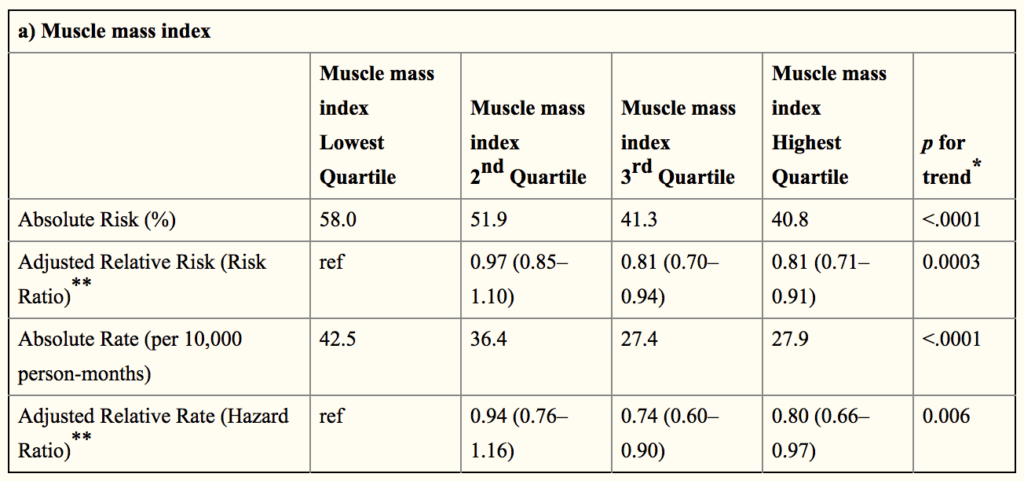
Unadjusted and Adjusted all-cause mortality risk (% mortality) and rate (number of deaths per 10,000 person-months) as a function of sex-specific quartiles of Muscle mass index. Credit:
Muscle Mass Index as a Predictor of Longevity in Older-Adults, Preethi Srikanthan, M.D., M.S. and Arun S. Karlamangla, M.D., Ph.D, https://www.ncbi.nlm.nih.gov/pmc/articles/PMC4035379/
However, exercise vs. health and mortality has a J shaped curve. So, more is better up to a point. That point is around 10 hours of vigorous exercise or 15 hours of moderate exercise. And exercise should be broken up if possible. For example, 3 30 minute sessions are more beneficial than one 90 minute session.
I jotted down some workout notes of stuff that I do. Please note though that we are all different. Some of the things that are good for my body type are terrible for others, and vice versa. And I would be surprised if I don’t find new exercises and new techniques over the years. If I do I will try to update this.
- Lats seem to do better if I keep the rep range rather high (10-14)
- Traps – I usually superset these. Hex bar shrugs: light weight for 5 or 6 reps with 15 second tempo, followed immediately by heavy weight for 4-5 reps, 2 second tempo. I use the hex bar for the heavy weight shrugs.
- Chest – 5-10 rep range. I like flat flyes but primarily use bench press and incline press (various angles – high angles get my delts in addition to chest).
- Delts – I mostly use military presses. I have noticed or perhaps imagined that since I have been using testosterone I don’t have many body aches and pains. I’ve been able to do military presses like I did as a 20 year old (just the intensity, not the same weight!).
- Deadlifts – an excellent mass builder for most of us. I don’t want to mess up my back so usually go fairly light and strict. 6-10 reps but lots of “headroom”- i.e. I could do more but again I don’t want form to suffer and risk an injury. I usually do these with lats since they not only hit legs and lower back they also hit my upper back and even my traps and forearms and biceps. The only varieties that I’ve found that work for me are stiff legged deadlifts and regular deadlifts. I love the hex bar and use it for shrugs and deadlifts. I hated doing them until I got the hex bar. Now shrugs are one of my favorite exercises.
- Forearms – I don’t do much forearm work. Maybe 3 sets of wrist curls a week.
- Biceps – I like doing biceps even though it is a tiny little show muscle and relatively meaningless. 6-12 sets.
- Triceps – same thing as biceps.
- Generally I keep things around 3-5 sets per exercise. Maybe 2 or 3 exercises per bodypart.
- Throw out all of the above😊 I mix it up a lot. Muscles adapt – I’ve found two weeks for me. Then throw them a curve. Lots of sets, or light with short rests (30s or so), or intensity, or use a power program with long rests (5 sets of 5 reps with 4 or 5 minute rests between sets), arms and lats and traps sometimes throw them a blood flow restriction (BFR) workout. Superset a couple of body parts (maybe lats and traps or triceps and biceps).
- I take a bunch of supplements 30 minutes or so before workouts. Creatine works wonders and I’ve used it almost continuously since 1994.
These are the sups I take on most days (on Keto I limit the carbs and sometimes the protein). Many of them have anti-cancer actions as well:
30+ protein, 50g+ carbs, some fat (a ounce of walnuts satisfies this), 5g bicarbs (e.g. baking soda), 5g creatine (split pre and post wo), 5g taurine, 5g beta alanine, 500mg curcumin, 1g turmeric, 20mg bioperine, black pepper, EGCG, green tea, 500mg bitter orange, 2g ALCAR, 1g HMB, 500mg ashwagandha, 8oz grapefruit juice and some lecithin (absorption and get CYP17 enzyme out of the way).
Days when I do Legs, Chest or Lats: 20mg synephrine, 60mg salicylic acid, 10mg yohimbine, 200mg theanine, 200mg caffeine
- Example of tempo: 4010: 4 seconds down/no pause/1 second concentric or up/no pause. I usually do a tempo like this one. Almost always longer on eccentric or lowering the weight. Exceptions are for BFR and power stuff. BFR I do a quick 2 second tempo and concentrate on just squeezing the muscle during the contraction, power stuff I do a 3 or 4 second tempo. Strict but not as slow.
- The exercises that work for me aren’t necessarily going to work for others. For example, flat flyes give me a heck of a workout and dips give me poor results and stress my cartilage. I can use more weight on flat flyes than I can on dumbbell presses. Usually it would be the opposite and I’ve never known anyone who gets the workout I get from flat flyes. I also love leg extensions. Seem almost as good as squats and they hit my quads even better than squats do. They hurt most people’s knees but don’t seem to stress mine very much. Particularly if I go strict and slow.
- For squats I usually put my legs out in front, do them on a smith machine, put my feet out fairly wide, focus on the glutes (glutes are the largest muscle group in the body, or at least they should be).
- I keep workouts to maybe an hour, but I often workout 2 or 3 times in a day. Excessive but I love working out and always have. If my workouts go longer than maybe 45 minutes I take longer rests between sets. Cortisol supposedly starts going up after about 45 minutes. Long rests might keep it down. I’m getting the test supplies and I’m about to test this out on myself. Baseline reading, 30 minutes, 60 minutes, 2 hours.
- I don’t like rest days but they’re important. I reframed the way I thought of them so instead of “rest days” I think of them as “growth days”. That’s really what they are but thinking rest bugs me. Growth makes them a lot easier for me. So on one or two days a week I “grow”.
I rotate weight schemes. Light a few times a year. I don’t feel the light stuff but throw it in once in a while. 15+ reps. Slowish 4-8 second tempos. Pain in the rear though and I don’t feel it as much – just pain.
Medium is 8-12 reps and might be best for hypertrophy. I stay in this range maybe 65% of the time.
Heavy is 4-6 reps. I enjoy heavy and maybe do it a little too often. Someday I’m going to have to slow down or abandon this to avoid injury. I stay in this range maybe 30-35% of the time.
I don’t do this every workout but intensity stuff works well for me, especially as I get older. So super sets, pre exhaust, rest pause (I do maybe 8 reps of something to failure, rest 15-25 seconds, squeeze out another 3 or so reps, rest another 15-25 seconds, squeeze out another rep or two, I never go beyond “3” rest pause cycles. Strip sets (like running the rack). Pre exhaust doesn’t work for a lot of guys but it seems to work well for me. Like maybe a set of leg curls followed immediately by a set of squats. Or leg extensions followed by squats. Or bench press followed by dumbbell flyes.
I’ve been using testosterone cypionate for over a year and that might explain why I can workout so much and heal so rapidly. But, that said, before PCa I was able to workout as often as I wanted and I healed up quickly. Just seems like the healing is even quicker today.
One thing that seems to work wonders for me is a program that I call the New Mexico Method (I used to work at White Sands Missile Range in New Mexico). It’s similar to the Texas Method but has a tweak. The tweak is some light sets using blood flow restriction (BFR). Google this if you don’t know what it is. Awesome pump. I love it for arms in particular. The BFR wraps are nice but you can do the same thing with a bandana wrapped around your arm or leg.
NMM is a program that I use once a month or so for a given bodypart. Works well for compound big muscle group exercises (I use it for military press (very occasionally since military presses tear up my shoulders and back if I’m not careful), bench press, incline press, lat pulldowns and cable rows, squats, but I am trying it now for barbell curls and lying tricep extensions). I’ve never failed to go up substantially in weights when I do an NMM cycle. I usually don’t get sore though and it doesn’t seem like a hypertrophy program. Strength only but makes a huge difference. Last month I did 6 (2 cycles) of military press. My military press went up 20.0%.
Here is an NMM program I’m going through now. All the weights are set as percentages of a 5 rep max (45 IP is 45 degree inc press – I use a smith machine, not as good as free weights but I’d rather trade a little effectiveness to prevent injuries – healed up in hours or at most days when I was younger. Now, who knows?). AMRAP is “as many reps as possible” I usually get about 3 but sometimes 5 or 6, and sometimes I even have to increase the programmed weight to keep the reps below 8 – again, works amazing for power increases. (45 IP is 45 degree incline press – I use a smith machine for safety reason, 5RM is 5 rep max).
| Day 1 | 12/5/2020 | 45 IP | 5RM: | 220 | Day 3 | Day 5 | ||||||||||||||||||||||||||||
| weight | reps | Tempo | rest | weight | reps | Tempo | rest | weight | reps | Temp | rest | |||||||||||||||||||||||
| 220 | 50% | 1 | BFR | 45 IP | 110 | 25 | 2 | 30 | 220 | 50% | 1 | BFR | 45 IP | 110 | 25 | 2 | 30 | 220 | 50% | 1 | BFR | 45 IP | 110 | 25 | 2 | 30 | ||||||||
| 220 | 55% | 1 | BFR | 45 IP | 121 | 15 | 2 | 30 | 220 | 55% | 1 | BFR | 45 IP | 121 | 15 | 2 | 30 | 220 | 55% | 1 | BFR | 45 IP | 121 | 15 | 2 | 30 | ||||||||
| 220 | 55% | 1 | BFR | 45 IP | 121 | 10 | 2 | 120 | 220 | 55% | 1 | BFR | 45 IP | 121 | 10 | 2 | 120 | 220 | 55% | 1 | BFR | 45 IP | 121 | 10 | 2 | 120 | ||||||||
| 220 | 90% | 1 | 45 IP | 198 | 2 | 3 | 120 | 220 | 90% | 1 | 45 IP | 198 | 2 | 3 | 120 | 220 | 100% | 1 | 45 IP | 220 | 2 | 3 | 120 | |||||||||||
| 220 | 90% | 1 | 45 IP | 198 | 5 | 3 | 300 | 220 | 90% | 1 | 45 IP | 198 | 5 | 3 | 300 | 220 | 105% | 1 | AMRAP | 45 IP | 231 | 3 | 3 | 45 | ||||||||||
| 220 | 90% | 1 | 45 IP | 198 | 5 | 3 | 300 | 220 | 90% | 1 | 45 IP | 198 | 5 | 3 | 300 | 220 | 50% | 1 | BFR | 45 IP | 110 | 25 | 2 | 30 | ||||||||||
| 220 | 90% | 1 | 45 IP | 198 | 5 | 3 | 300 | 220 | 90% | 1 | 45 IP | 198 | 5 | 3 | 45 | 220 | 55% | 1 | BFR | 45 IP | 121 | 15 | 2 | 30 | ||||||||||
| 220 | 90% | 1 | 45 IP | 198 | 5 | 3 | 300 | 220 | 50% | 1 | BFR | 45 IP | 110 | 25 | 2 | 30 | 220 | 55% | 1 | BFR | 45 IP | 121 | 10 | 2 | 120 | |||||||||
| 220 | 90% | 1 | 45 IP | 198 | 5 | 3 | 45 | 220 | 55% | 1 | BFR | 45 IP | 121 | 15 | 2 | 30 | ||||||||||||||||||
| 220 | 50% | 1 | BFR | 45 IP | 110 | 25 | 2 | 30 | 220 | 55% | 1 | BFR | 45 IP | 121 | 10 | 2 | 120 | |||||||||||||||||
| 220 | 55% | 1 | BFR | 45 IP | 121 | 15 | 2 | 30 | ||||||||||||||||||||||||||
| 220 | 55% | 1 | BFR | 45 IP | 121 | 10 | 2 | 120 |
Some of the exercises I do are (ones I like best are bold and italicized. My all time favorite exercises are in blue)
Abdominals:
- weighted cable crunch
- legs on bench crunch
- decline crunch (using ab bench)
- decline twisters (or bicycles). Intensity can be added by holding a medicine ball and twisting side to side with it.
- rockys (leg raises)
Biceps:
- barbell curl
- chinups (weighted or unweighted – sometimes just top 1/3 of movement only with intense contraction on biceps)
- banded dumbbell curl
- cheat barbell curl / drag barbell curl
- 8x supinated dumbbell curl, 8x pronated dumbbell curl, 8x supinated dumbbell curl
- preacher curl (I never go heavy on these since they place a lot of stress on the elbow)
- dumbell hammer curl, and barbell hammer curl using a tricep bar
- zottman curl
- standing dumbbell curl and incline bench dumbbell curl
Chest
- incline press, 30, 45, 60, 75 degree incline on bench
- bench press
- flat flye
- incline flye
- wide grip bench press
- dumbbell press
Deltoids
- military press kneeling on ground using smith machine
- side lateral raises
- front lateral raises
- back lateral raises
Forearms
- wrist curl (best by far but I only do a few sets of forearms each week)
- reverse wrist curl
Glutes. Very important since glutes are 30%+ of muscle mass in the body.
- Lying leg curls. Really concentrate on these and flex the glutes.
- Stiff leg dead lift.
- Reverse hyper
- kettlebell sumo squats
- hip thrusts (I don’t find these very effective)
- glute bridges (I don’t find these very effective)
- cable kick back (effective but hard to do right)
Lats
- Hammer chinups
- Pullups
- Close grip lat pull down
- Wide grip lat pull down
- Medium grip lat pull down
- Cable rows
Legs
- Leg curl (great for glutes if squeezing the glutes, great for hamstrings if concentrating on hams)
- Leg extension (do these strict or you could hurt your knees)
- Dead lift, king of exercises for me. Hits legs, back, ribcage, arms, traps, even abs. But I need to do them strict and fairly light or I risk a back injury.
- Smith machine inverted leg press
- Squats. Another great exercise. Second only to dead lifts. Feet out in front and toes wide and it works the glutes and hams. Feet closer together and more under the body and it works the quads.
- Leg press
- Calf raises on leg press machine or with bar or dumbbells or with kettlebell
Traps
- Shrugs. Great exercise for my physique. By far my favorite is using a hex bar. Lots of other variations though. Smith machine, barbell, dumbbell, kettlebell (I like using a 100 lb kettlebell to warmup or for BFR work).
- Behind the back shrugs.
- Neck extensions.
Triceps
- Dumbbell french press
- Lying tricep extension (can use dumbbell or ez curl bar – this is my favorite tricep exercise)
- Cable press down (I like these for BFR and as a change from lying tricep extensions)
- Rope cable press down
- Reverse cable press down
- Ez bar french press.
Resistance bands are a nice way to get started. They are also useful for travelling. If you don’t or can’t mess around with weights, the resistance bands can be used to get a good workout. They are also useful for rehab (I ruined my right delt in my 20s and used resistance bands for 6 months to rehab it – after 6 months it was almost as good as new).
If you find any of this stuff interesting and would like a description of one or more things let me know. I’m more than happy to help – also helps me because with feedback I know what might be clear in my blog.
Selected references:
- Exercise-induced biochemical changes and their potential influence on cancer: a scientific review: Robert James Thomas, Stacey A Kenfield, Alfonso Jimenez: https://bjsm.bmj.com/content/bjsports/early/2016/12/19/bjsports-2016-096343.full.pdf
- A prospective study of physical activity and incident and fatal prostate cancer: Edward L Giovannucci, Yan Liu, Michael F Leitzman, Meir J Stamfer, Walter C Willett: https://pubmed.ncbi.nlm.nih.gov/15883238
- Recreational Physical Activity in Relation to Prostate Cancer-specific Mortality Among Men with Nonmetastatic Prostate Cancer: Ying Wang, Eric J Jacobs, Susan M Gapstur, Maret L Maliniak, Ted Gansler, Marjorie L McCullough, Victoria L Stevens , Alpa V Patel: https://pubmed.ncbi.nlm.nih.gov/28711382/
- MET-hour equivalents of various physical activities: https://www.health.harvard.edu/staying-healthy/met-hour-equivalents-of-various-physical-activities
- Muscle Mass Index as a Predictor of Longevity in Older-Adults: Preethi Srikanthan, M.D., M.S. and Arun S. Karlamangla, M.D., Ph.D: https://www.ncbi.nlm.nih.gov/pmc/articles/PMC4035379/
- Why Exercise Is Important When You Have Prostate Cancer, and the Best Workouts to Do: Maria C Masters: https://www.livestrong.com/article/13729727-exercise-and-prostate-cancer/?fbclid=IwAR2pdlL-Rl-fpmU69yuiQrkiZUEllPr8k4VYb76dqE6AjCx2bCBigFOrD80
- High intensity exercise releases a boatload of myokynes. “Surprisingly, myokine inhibition also induces prostate tumor regression in the absence of ADT, and increased the rate and degree of castration induced prostate tumor regression in this model. These results suggests that myokines might be both biomarkers and potential targets for therapy to reduce this co‐morbidity in prostate cancer patients and may also control tumor growth directly.”
- Muscle–Organ Crosstalk: The Emerging Roles of Myokines: Mai Charlotte Krogh Severinsen, Bente Klarlund Pedersen: https://academic.oup.com/edrv/article/41/4/594/5835999
- Exercise-induced biochemical changes and their potential influence on cancer: a scientific review: Robert James Thomas, Stacey A Kenfield, Alfonso Jimenez: https://bjsm.bmj.com/content/51/8/640?fbclid=IwAR3V-0UgFzp-UD6Eza9sJXonk5ze_voi20ph3645-5I8CMfvCgAizF1rKDM
- Myokine Signaling Blockade Prevents Androgen Deprivation Therapy Induced Sarcopenia and Suppresses Tumor Growth: Chunliu Pan Shalini Singh John Krolewski Kent Nastiuk https://faseb.onlinelibrary.wiley.com/doi/abs/10.1096/fasebj.31.1_supplement.901.10
 Prostate Cancer Adventures